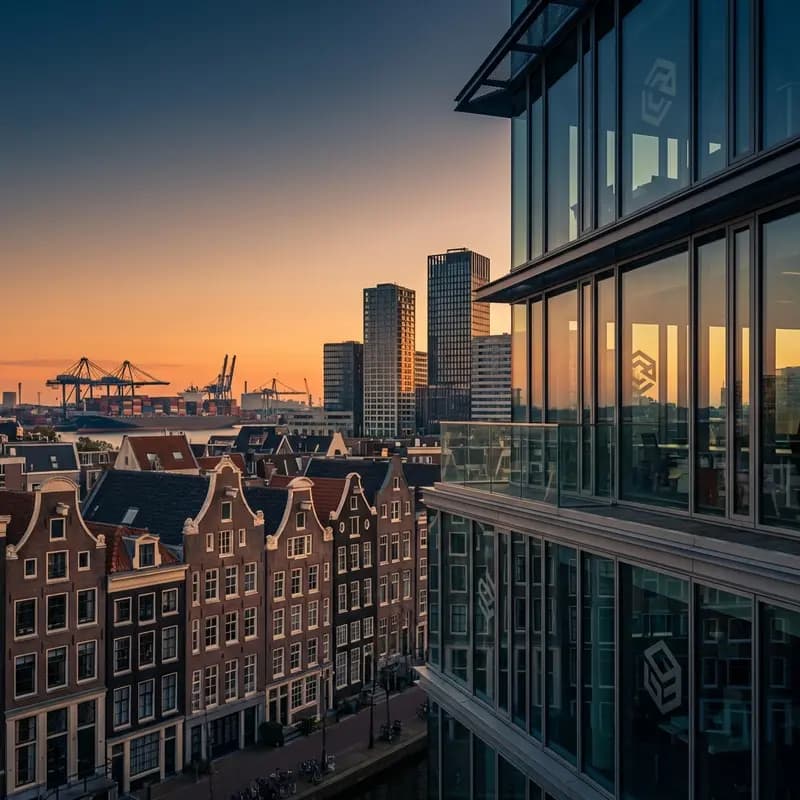
The Netherlands stands as one of Europe's most attractive destinations for international business. With its strategic location at the crossroads of European trade routes, world-class infrastructure including the Port of Rotterdam and Schiphol Airport, a highly educated multilingual workforce, and a business-friendly regulatory environment, the Netherlands offers an exceptional platform for companies looking to access the European market.
1.Dutch Company Types and Choosing the Right Structure
The Netherlands offers several legal structures for establishing a business, each suited to different needs:
BV (Besloten Vennootschap): The most popular structure for both domestic and foreign entrepreneurs. Since the 2012 Flex-BV reform, the minimum share capital has been reduced to just €0.01, making it highly accessible. Shareholders' liability is limited to their capital contribution. Share transfers are restricted and require notarial approval.
NV (Naamloze Vennootschap): The public limited company equivalent, requiring a minimum capital of €45,000. Shares can be freely traded, making it suitable for larger enterprises planning a stock exchange listing. An NV requires both a management board and, in many cases, a supervisory board.
VOF (Vennootschap onder Firma): A general partnership formed by two or more partners who are jointly and severally liable for the company's debts. No minimum capital is required. The VOF itself is not a legal entity, but it must be registered with the KVK.
Eenmanszaak: A sole proprietorship — the simplest business form in the Netherlands. No notarial deed is required, and registration with the KVK is straightforward. The owner bears unlimited personal liability.
CV (Commanditaire Vennootschap): A limited partnership with at least one general partner (beherende vennoot) bearing unlimited liability and one or more silent partners (commanditaire vennoten) whose liability is limited to their investment.
Stichting: A foundation structure that can engage in commercial activities but cannot distribute profits to its founders or board members. Often used in holding structures and social enterprises.
2.Company Name and Trade Name Rules
Choosing a company name in the Netherlands is governed by the Handelsnaamwet (Trade Name Act). The name must not be misleading regarding the nature or scope of the business. For a BV, the suffix "B.V." must be included in the official name. The name should be distinguishable from existing registrations in the KVK trade register. While the KVK does not formally approve names, it will flag potential conflicts. Foreign-language names are permitted, and there is no requirement for the name to be in Dutch.
3.Notarial Deed of Incorporation
Forming a BV or NV in the Netherlands requires a notarial deed of incorporation (akte van oprichting) executed by a Dutch civil-law notary (notaris). This deed contains the company's articles of association (statuten), which define the company's purpose, share capital structure, management rules, and shareholder rights. Prior to execution, the notary conducts identity verification and anti-money laundering checks under the Wwft (Wet ter voorkoming van witwassen en financieren van terrorisme). The notary also obtains a declaration of no objection from the Ministry of Justice. Notarial fees typically range from €500 to €1,500 depending on complexity.
4.Bank Account Opening and Capital Requirements
Thanks to the 2012 Flex-BV legislation, the minimum capital requirement for a BV is just €0.01. However, directors should ensure the company is adequately capitalized for its intended activities, as they may face personal liability under the "manifest unreasonableness" test if the company is undercapitalized.
Opening a Dutch business bank account requires the KVK registration extract, identification documents of all directors and UBOs (Ultimate Beneficial Owners), and often a business plan. Major Dutch banks include ING, ABN AMRO, Rabobank, and de Volksbank. Digital banks like bunq also offer business accounts with faster onboarding.
For an NV, the minimum capital is €45,000, with at least one-fifth to be paid up at incorporation.
5.KVK (Chamber of Commerce) Registration
All businesses operating in the Netherlands must register with the KVK (Kamer van Koophandel — Chamber of Commerce). This registration enters the company into the Handelsregister (Trade Register) and is a legal requirement.
The registration process:
• The notary prepares and executes the deed of incorporation
• An appointment is scheduled with the KVK (online or by phone)
• Founders attend the KVK office with identification documents
• Company details are entered into the Handelsregister
• A KVK number and RSIN (legal entities identification number) are issued
Registration is typically completed on the same day and costs approximately €75. The KVK number must appear on all business correspondence, invoices, and the company website. The KVK automatically notifies the Belastingdienst (Tax Authority) of the new registration.
6.Tax Registration and the Dutch Tax System
Following KVK registration, the Belastingdienst (Dutch Tax Authority) automatically assigns a tax identification number. The Netherlands offers a competitive and transparent tax framework:
• Vennootschapsbelasting (Corporate Income Tax): A two-bracket system — 15% on the first €200,000 of taxable profit and 25.8% on profits exceeding that threshold.
• Dividendbelasting (Dividend Withholding Tax): 15% on dividend distributions, with reductions available under EU directives and bilateral tax treaties.
• Loonbelasting (Wage Tax): Employers must withhold income tax from employee salaries through the payroll system.
The Netherlands has an extensive network of over 100 double taxation treaties, making it one of the most favorable jurisdictions for international holding and trading structures. The participation exemption (deelnemingsvrijstelling) allows qualifying dividends and capital gains from subsidiaries to be fully exempt from corporate tax.
7.BTW (VAT) Registration and Obligations
Businesses supplying goods or services in the Netherlands must register for BTW (Belasting over de Toegevoegde Waarde — Value Added Tax).
BTW rates:
• Standard rate: 21% (most goods and services)
• Reduced rate: 9% (food, pharmaceuticals, books, hotel accommodation, cultural events, passenger transport)
• Zero rate: 0% (intra-EU supplies and exports outside the EU)
BTW returns are generally filed quarterly, though businesses with high turnover may file monthly. Companies engaged in intra-EU trade must also submit Intracommunautaire Prestaties (ICP) declarations. The kleineondernemersregeling (small business scheme) may exempt businesses with annual BTW liability below €1,800.
8.The 30% Ruling for Skilled Migrants
One of the Netherlands' most attractive tax incentives is the 30% ruling (30%-regeling), designed to attract highly skilled international workers.
Under this arrangement, employers may pay up to 30% of the employee's gross salary as a tax-free allowance to compensate for the extraterritorial costs of working in the Netherlands.
Eligibility requirements:
• The employee must have been recruited from abroad or transferred from a foreign entity
• The employee must have lived more than 150 km from the Dutch border for at least 16 of the 24 months prior to employment
• The employee must possess specific expertise that is scarce in the Dutch labor market
• A minimum salary threshold must be met (approximately €46,107 for 2024; €35,048 for employees under 30 with a Dutch master's degree or equivalent)
The ruling applies for a maximum of 5 years (as of 2024). During this period, the employee may also opt for partial non-resident taxpayer status for Box 2 and Box 3 income, and can exchange a foreign driving license for a Dutch one without additional testing.
9.Innovation Box Regime
The Dutch Innovation Box (Innovatiebox) provides a significantly reduced effective tax rate of 9% on qualifying income derived from innovative activities, compared to the standard 25.8% corporate tax rate.
Qualifying conditions:
• The company must have developed or co-developed qualifying intellectual property (IP)
• A WBSO certificate (Wet Bevordering Speur- en Ontwikkelingswerk — R&D Tax Credit Act) must be obtained
• Qualifying IP includes patents, software, and plant breeders' rights
The Innovation Box is particularly beneficial for technology companies, software developers, and R&D-intensive businesses. Combined with the WBSO program — which provides a reduction in wage tax and social security contributions for R&D employees — the Netherlands offers one of Europe's most competitive environments for innovation-driven enterprises.
Companies must track qualifying and non-qualifying income separately. The benefit is calculated using the "nexus approach" aligned with OECD guidelines.
10.Dutch Labor Law and UWV Social Security
Dutch labor law provides strong protections for employees, and employers must navigate a comprehensive regulatory framework:
Employment Contracts: Written contracts are mandatory. Both fixed-term and indefinite contracts are recognized. Under the ketenregeling (chain rule), three consecutive fixed-term contracts or contracts exceeding 36 months in total automatically convert to an indefinite contract.
Minimum Wage: The Netherlands sets a statutory minimum wage (wettelijk minimumloon) that is adjusted twice yearly. As of 2024, it is calculated on an hourly basis for employees aged 21 and over.
Leave Entitlements: Employees are entitled to a minimum of four times their weekly working hours in annual leave (typically 20 days for full-time). Sick employees must receive at least 70% of their salary for up to two years, with the first year requiring at least the minimum wage.
UWV (Uitvoeringsinstituut Werknemersverzekeringen): The Dutch social security administration. Employers contribute to:
• WW (Werkloosheidswet — Unemployment Insurance)
• WIA (Wet werk en inkomen naar arbeidsvermogen — Disability Insurance)
• ZVW (Zorgverzekeringswet — Health Insurance Act contribution)
Dismissal Protection: Terminating an employee in the Netherlands requires either UWV approval (for economic reasons or long-term illness) or court approval (kantonrechter) for personal reasons. A statutory transition payment (transitievergoeding) is always due upon dismissal.
11.Accounting and Financial Reporting
All Dutch companies are subject to statutory bookkeeping and reporting obligations. BV and NV structures must maintain double-entry bookkeeping.
Key obligations:
• Preparation of annual financial statements (jaarrekening) including balance sheet, profit and loss account, and notes
• Filing (deponering) of annual accounts with the KVK within the statutory deadline
• Corporate income tax return (aangifte vennootschapsbelasting)
• Quarterly or monthly BTW returns
• Payroll tax returns (loonaangifte)
Companies are classified as micro, small, medium, or large based on assets, revenue, and employee count. Small companies benefit from simplified reporting requirements and are exempt from mandatory audits. Medium and large companies must have their accounts audited by a registered accountant (registeraccountant).
Annual accounts must be prepared within 5 months of the financial year-end, with a possible 5-month extension. They must be adopted by the general meeting within 2 months thereafter and filed with the KVK within 8 days of adoption.
12.Logistics Advantages: Rotterdam and Schiphol
The Netherlands is widely recognized as Europe's logistics gateway, anchored by two world-class infrastructure hubs:
Port of Rotterdam: Europe's largest seaport and among the top 10 globally, handling over 450 million tonnes of cargo annually. It serves as the primary entry point for goods entering the European continent, with particular strength in petrochemicals, container shipping, and energy commodities.
Schiphol Airport: One of Europe's busiest airports, offering direct connections to over 300 destinations worldwide. It ranks as Europe's third-largest cargo airport, making it a critical hub for time-sensitive and high-value shipments.
Infrastructure strengths:
• One of Europe's densest and best-maintained motorway networks
• Extensive inland waterway system via the Rhine and Meuse rivers
• High-speed rail connections (Thalys, Eurostar, ICE)
• Digital infrastructure leadership: AMS-IX is one of the world's largest internet exchange points
These advantages make the Netherlands an ideal base for e-commerce fulfillment, European distribution centers, and supply chain management operations. Over 60% of European distribution centers of US and Asian companies are located in the Netherlands.
Establishing a company in the Netherlands offers a compelling combination of low entry barriers through the Flex-BV structure, a competitive and transparent tax system, powerful innovation incentives, and unmatched logistics infrastructure. We provide full post-formation support including accounting, tax compliance, social security administration, and legal advisory to ensure your business thrives on solid foundations.
The Dutch Economic Landscape
The Netherlands has a GDP of approximately €1 trillion, making it the fifth-largest economy in the EU and seventeenth globally. It consistently ranks among the highest in Europe for GDP per capita. With trade exceeding 150% of GDP, it is one of the world's most open economies.
Foreign Investment Climate
The Netherlands is among the top global destinations for foreign direct investment. The NFIA (Netherlands Foreign Investment Agency) provides free advisory services to international companies. Over 4,000 multinational corporations have established their European headquarters in the country, including major names in technology, consumer goods, and financial services.
Strategic Position
Situated at the heart of Western Europe, the Netherlands provides access to over 500 million consumers. An estimated 95% of the EU's most lucrative consumer markets can be reached within 24 hours by road. Rotterdam and Schiphol reinforce this position as Europe's primary logistics corridor.
Innovation Ecosystem
The Netherlands invests approximately 2.3% of GDP in research and development. The Eindhoven Brainport region is home to global technology leaders such as ASML, Philips, and NXP Semiconductors. The country consistently ranks in the top 10 of the Global Innovation Index.