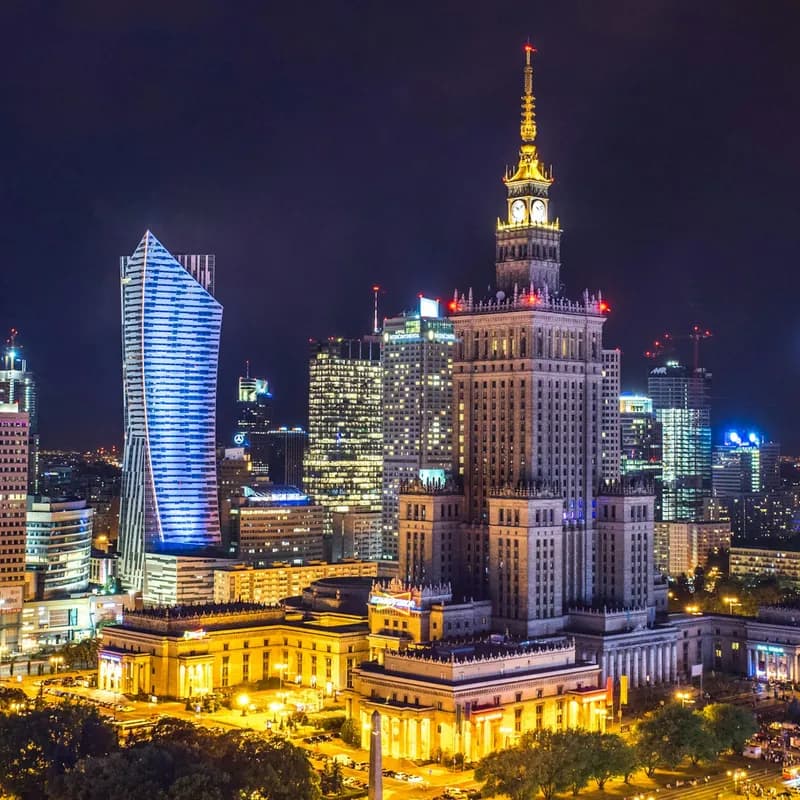
Poland is the largest e-commerce market in Central and Eastern Europe and one of the fastest-growing in the European Union, with online retail worth well over PLN 100 billion a year and still taking share from physical stores. It is also the most distinctive market in Europe, because the platform that dominates it is not Amazon but Allegro, a Polish company founded in Poznań in 1999. Add a mobile payment standard almost unknown outside the country, a parcel-locker network that has reshaped consumer expectations of delivery, and a tax administration that reads your sales records monthly, and the conclusion is clear: a Polish storefront that simply mirrors a German or British one will underperform badly.
1.The Shape of the Polish Online Market
Poland combines Western European purchasing habits with Central European price sensitivity, and the mix rewards operators who localise properly.
• Market size: Polish online retail is estimated in the region of PLN 120-140 billion a year as of 2025 — roughly EUR 30 billion — with online accounting for something over a tenth of total retail spending and continuing to grow faster than the economy as a whole.
• Reach: Around three quarters of Polish internet users buy online, and the buyer base is no longer concentrated in the big cities; parcel-locker coverage has pulled small towns and rural areas into the market.
• Mobile: More than half of traffic and a rapidly rising share of transactions happen on a phone, which is inseparable from the dominance of BLIK, a payment method designed for exactly that screen.
• Domestic first: Unlike almost every other EU market, the leading platform is homegrown. Allegro is where Polish consumers begin a product search, and international brands routinely discover that their Amazon playbook transfers poorly.
• Price sensitivity: Polish shoppers compare aggressively, using Ceneo and Allegro's own listing comparison before buying, and the arrival of Temu and Shein pushed the bottom of the market lower still.
The practical implication is that Poland is a localisation problem before it is a demand problem. Polish-language listings, Polish customer service, BLIK at checkout and locker delivery are not refinements — they are the conditions of competing at all.
2.Allegro: The Marketplace That Defines Polish Retail
Allegro is the single most important fact about Polish e-commerce. Founded in Poznań in 1999, listed on the Warsaw Stock Exchange in 2020 in what was then the largest IPO in the exchange's history, it carries the overwhelming majority of Polish marketplace volume and has well over ten million active buyers in a country of 38 million people. For a great many Polish shoppers it is not a channel but the default starting point.
Allegro Smart! is the subscription that locks in that habit. For an annual fee, members get free delivery to parcel lockers and pick-up points — and free returns — above a modest minimum basket value. Millions of households hold it, and the effect on merchant economics is decisive: a Smart!-eligible offer is compared against other Smart! offers, and an offer outside the programme is frequently not compared at all.
Getting on: Registration is open to foreign companies. You will need company registration documents, a Polish tax identification number (NIP) where you are registered for Polish VAT, a bank account that can receive payouts and, for many categories, documentation of authorisation to sell the brands you list.
Fees and ranking: Allegro charges a category-dependent commission on the sale value — broadly in the single digits to mid-teens as a percentage, with lower rates on high-value electronics and higher rates on accessories and apparel — plus optional listing and promotion charges. Rankings reward price, delivery speed, Smart! eligibility, offer quality and seller rating; consistent performance earns the Super Sprzedawca (Super Seller) badge, which visibly improves conversion. Allegro Ads sits on top as the main paid-visibility lever, with sponsored offers auctioned against competing listings.
3.Amazon.pl, Empik, Erli and the Chinese Arrivals
Allegro is not the whole field, and the secondary platforms matter more for some categories than their headline traffic suggests.
Amazon.pl opened only in March 2021, more than two decades after Allegro established itself, and remains a clear second. Amazon had operated Polish fulfilment centres since 2014, but they served German customers; the consumer-facing Polish store arrived late into an occupied market. It is growing, it is the natural channel for sellers already running Pan-European FBA, and Polish Prime members are a real audience — but a Poland strategy built on Amazon alone is a strategy built on the smaller share.
Empik is the heir to a chain of city-centre cultural stores, with a marketplace strong in books, media, toys, stationery and gifting, and a pick-up network in its own shops that converts well for those categories.
Erli is the most credible domestic challenger, launched in 2020 with an aggressive low-commission proposition explicitly aimed at merchants frustrated by Allegro's fees. Volumes are far smaller, but acquisition costs can be attractive.
Temu and Shein changed the floor. Both entered Poland in force from 2023 and reset consumer expectations of what cheap goods should cost, particularly in apparel, accessories and small household items. Regulators have taken an active interest in their consumer-facing practices, and the EU's treatment of low-value imported consignments is under review — but the price anchoring has already happened. Mid-market sellers respond with brand, speed, service and warranty credibility rather than by chasing the price.
Specialists such as Morele.net, x-kom and Media Expert dominate parts of electronics and should be assessed category by category.
4.Your Own Store: Platforms, Ceneo and Paid Traffic
An owned store protects margin and customer relationships, and in Poland it also frees you from the single-platform dependence that Allegro otherwise creates. The platform landscape is genuinely local.
• Shoper — a Polish SaaS platform, publicly listed, and the most common choice for small and mid-sized Polish merchants. Native Polish payments, couriers, invoicing and marketplace integrations out of the box.
• IdoSell — the other established Polish SaaS option, built by IAI, stronger on omnichannel, warehouse logic and multi-language cross-border selling.
• PrestaShop — disproportionately popular in Poland compared with most markets, with a deep local agency and module ecosystem for merchants who want open source with support available in Polish.
• WooCommerce — widely used at the small end, cheap to start, and entirely dependent on the quality of the hosting and maintenance behind it.
• Shopify — growing, and the usual choice for international brands entering Poland, but it needs deliberate localisation: BLIK, Przelewy24 or PayU, InPost locker selection at checkout, Polish invoicing and a Polish returns address.
BaseLinker deserves a line of its own. This Polish multi-channel management tool sits between your store, Allegro, Amazon, couriers and accounting, and is close to standard practice for sellers running several channels at once.
Traffic: Ceneo, the price-comparison engine that sits within the Allegro group, is a primary acquisition channel for own-store merchants and demands a clean, complete product feed. Google Ads and Shopping work as they do elsewhere, and influencer selling through Instagram, TikTok and YouTube is well developed in beauty, fashion and home categories.
5.Payments: BLIK, Przelewy24 and the Cash-on-Delivery Habit
Polish checkout habits differ sharply from Western Europe, and the single most expensive mistake a foreign merchant makes is offering a card-only checkout.
BLIK is the country's mobile payment standard, created by a consortium of the largest Polish banks and built into virtually every Polish banking app. The customer generates a six-digit code, enters it at checkout and confirms in the app; funds move instantly from the bank account with no card involved. It handles well over a billion transactions a year and is the leading online payment method in Poland by a wide margin, especially on mobile. A Polish checkout without BLIK converts poorly — shoppers who do not see it frequently assume the merchant is foreign, untrustworthy or both.
Pay-by-link bank transfers are the second pillar. The customer is redirected into their own online banking to approve a pre-filled transfer. Polish shoppers trust their banks, and this route carries volume that would go to cards elsewhere.
The gateways: Przelewy24 (P24) and PayU are the two most widely deployed, both bundling BLIK, pay-by-link across every major Polish bank, cards and wallets. Tpay, Autopay and bank-owned gateways such as mBank's Paynow are credible alternatives. Cards remain important but are not the default, and Apple Pay and Google Pay are established.
Cash on delivery (pobranie) persists. It has declined steadily but is still expected in some categories and among older or first-time buyers, and it brings higher refusal rates and working-capital drag. Buy now, pay later — PayPo, Klarna and Allegro Pay — has grown quickly and now competes for the same hesitant buyer.
6.Delivery: InPost Paczkomaty and the Locker Economy
No European country has embraced parcel lockers as completely as Poland, and delivery expectations are shaped accordingly.
InPost Paczkomaty are the reference point. InPost operates well over twenty thousand automated lockers across Poland as of 2025 — in supermarket car parks, at petrol stations, outside blocks of flats — giving most of the population a machine within a short walk. The customer picks a locker at checkout, receives a code, and collects at any hour without waiting for a courier. Locker delivery is also the cheapest option, typically costing the merchant single-digit to low-teens zloty at volume, and a large share of Polish e-commerce parcels now move this way.
The consequence for merchants is blunt: offering locker delivery is mandatory. A checkout with couriers only will lose orders to competitors who offer Paczkomat, and Allegro Smart! has cemented the expectation that locker delivery is free above a low basket value.
The courier field: DPD Polska, DHL Parcel and GLS cover home and business delivery competently; UPS and FedEx serve express and international lanes; Poczta Polska reaches every address and remains relevant for the smallest and lightest items; Orlen Paczka runs an alternative pick-up network through petrol stations and partner points; Allegro One Box is Allegro's own locker estate, and Żabka convenience stores act as widespread collection points.
Realistic expectations: Poland is compact and domestic transit is overwhelmingly next day for orders placed by the afternoon cut-off. Free delivery thresholds are standard, and a slow or expensive delivery promise is visible immediately in Allegro rankings.
7.VAT, OSS and Invoicing: JPK_V7 and the KSeF Rollout
Polish VAT is conventional in structure and demanding in administration.
Rates: The standard rate is 23%. Reduced rates of 8% (including many foodstuffs, pharmaceuticals and certain services) and 5% (basic foods, books, periodicals) apply, with 0% for intra-EU supplies and exports. Classification errors are a common and expensive source of correction.
Registration: Foreign sellers register on form VAT-R and receive a Polish NIP; intra-EU trade additionally requires VAT-UE registration. Non-EU businesses generally need a fiscal representative. Registration in Poland becomes unavoidable once you hold stock in the country, regardless of where your customers are.
Cross-border B2C: There is a single EU-wide distance-selling threshold of EUR 10,000 covering all your cross-border B2C goods and electronic services combined. Below it you may keep charging your home-country VAT; above it, VAT is due where the customer is, and the One-Stop Shop (OSS) lets you declare all of it through one quarterly return in one member state instead of registering everywhere. IOSS covers imported consignments with an intrinsic value up to EUR 150, allowing VAT to be collected at the point of sale and the parcel to clear customs smoothly.
JPK_V7: Every Polish VAT registrant files JPK_V7M monthly (or JPK_V7K for quarterly filers) — a single XML file combining the VAT return with the full sales and purchase records, due by the 25th of the following month. It is machine-read, it must reconcile, and errors invite immediate queries.
Invoicing and KSeF: B2B invoices follow standard EU content rules. Poland's Krajowy System e-Faktur (KSeF) is a national e-invoicing platform through which structured invoices are issued and delivered via the tax administration. It has been available voluntarily since 2022, and mandatory use is being introduced in phases by taxpayer size; the timetable has been rescheduled more than once, so confirm the applicable date before building your process. Note also the split payment mechanism, obligatory for listed goods on B2B invoices above PLN 15,000, and the white list of VAT taxpayers, which governs which bank accounts large payments may be sent to.
8.Consumer Law: Withdrawal Rights, Rękojmia and UOKiK
Polish consumer rules derive from EU directives and are implemented mainly through the Ustawa o prawach konsumenta (Consumer Rights Act of 30 May 2014) and the Kodeks cywilny (Civil Code). Enforcement is real.
1. The 14-day right of withdrawal. A consumer buying at distance may withdraw within 14 days of receiving the goods without giving any reason. Refund the full price, including the cheapest standard delivery you offered, within 14 days of being notified. You may withhold until the goods return or proof of dispatch arrives, and the customer normally pays return postage only if you told them so before the order. Exceptions cover personalised goods, perishables and sealed items unsuitable for return once opened.
2. Conformity and rękojmia. For consumer sales, rękojmia — the Civil Code statutory warranty that remains the rule between businesses — was replaced from 1 January 2023 by harmonised conformity with the contract rules. The trader is liable for two years for a lack of conformity existing at delivery, with a remedy ladder of repair or replacement first, then price reduction or withdrawal. For the first year, non-conformity is presumed to have existed at delivery. Separate rules cover digital content and services.
3. Pre-contractual information. Before the order button, disclose trader identity and contact details, the total price including tax and delivery, payment and delivery arrangements, the withdrawal right with a model form, complaint handling and the conformity guarantee. The order button must state unambiguously that it triggers a payment obligation.
4. Omnibus price rules. Since 2023, any announced price reduction must display the lowest price in the 30 days before the reduction. Rankings must be explained, paid placement disclosed, and reviews must be verified as coming from actual purchasers.
5. UOKiK. The competition and consumer protection authority is active in e-commerce, publishes its decisions, and can impose fines of up to 10% of turnover. Dark patterns, fake scarcity, misleading discounts and obstructive complaint handling are current priorities. Note too that sole traders buying outside their professional specialisation enjoy consumer-like protections.
9.Structure, ZUS and Poland as an EU Fulfilment Base
Sole trader or company? A jednoosobowa działalność gospodarcza (JDG) — registration in the CEIDG business register — is free, takes a day and suits a founder testing the market. Goods trading can often use the ryczałt lump-sum regime taxed on revenue at a low rate, which is attractive where costs are modest, with the flat 19% or progressive scale as alternatives. The catch is ZUS, the social insurance institution: contributions are flat-rate rather than profit-linked, so a bad month still costs the same. New entrepreneurs get relief — an initial exemption from social contributions, then a reduced-base period, then income-linked mechanisms — before full contributions of well over PLN 1,500 a month begin.
A spółka z ograniczoną odpowiedzialnością (sp. z o.o.) costs PLN 5,000 of share capital and brings limited liability, credibility with Allegro, banks and suppliers, and 9% corporate income tax for small taxpayers on operating income, against 19% otherwise. The trade-off is double taxation on dividends and full accounting books. One warning matters here: a sole shareholder of an sp. z o.o. is treated as a sole trader for ZUS purposes, so the single-member structure does not escape contributions.
Poland as a fulfilment base. Amazon operates a substantial network of Polish fulfilment centres — Wrocław, Poznań, Gliwice, Łódź, Szczecin and others — much of it built to serve German customers. Under Pan-European FBA, Amazon places stock wherever demand suggests, which routinely means Poland and triggers a Polish VAT registration. Many German and Western European sellers deliberately hold stock here: warehouse and labour costs are markedly lower, the road links to Berlin and the Czech border are short, and next-day delivery into Germany is achievable. Poland is therefore not only a market but a low-cost logistics platform for the whole European Union.
Poland rewards merchants who take its particularities seriously. The sellers who win here list on Allegro and make their offers Smart!-eligible, put BLIK and pay-by-link at the front of the checkout, offer Paczkomat delivery as standard, register for VAT and OSS before stock arrives rather than after, keep JPK_V7 filings clean, and build withdrawal, conformity and Omnibus pricing rules into the store rather than bolting them on after a UOKiK letter. At Astropel we support each of those steps — Allegro and marketplace onboarding, payment and courier integration, Polish VAT, OSS and IOSS registration, KSeF-ready invoicing, consumer-law review, entity formation and ZUS planning, and fulfilment strategy for sellers using Poland as their European base.
Three Decades of Uninterrupted Growth
Poland produces roughly EUR 800 billion of annual output, making it the largest economy in Central Europe and the sixth largest in the European Union. It grew every year from 1992 until the pandemic and was the only EU member state to avoid recession in 2009, a record no other European economy matches. Household incomes have converged steadily towards the EU average, and the country keeps its own currency, the zloty, alongside full single-market membership.
Manufacturing and Nearshoring
Industry accounts for a far larger share of output than in most of Western Europe. Poland is Europe's leading producer of household appliances, a major supplier of automotive components and batteries, and one of the world's largest furniture exporters. Costs well below the eurozone average, combined with EU regulatory standards and short road distances to Germany, have made it the principal destination for companies shortening supply chains out of Asia.
IT and Business Services
Around 400,000 people work in the modern business services sector, in shared service centres, IT operations and research and development, concentrated in Kraków, Warsaw, Wrocław, the Tri-City and Katowice. A deep pipeline of engineering and mathematics graduates and a long-standing reputation in software development support a domestic technology sector that also builds the country's e-commerce infrastructure, from Allegro and Shoper to InPost and BaseLinker.
The Central European Logistics Hub
Poland sits where the east-west and north-south freight corridors of the continent cross. Baltic deep-water ports at Gdańsk and Gdynia, the largest international road haulage fleet in the EU, rail gateways handling China-Europe freight and a motorway network financed by two decades of EU cohesion funding make it the natural distribution point for Central and Eastern Europe, and an increasingly common place for Western European sellers to hold stock.